
Wry Neck in Chickens: Causes, Symptoms, and Treatment
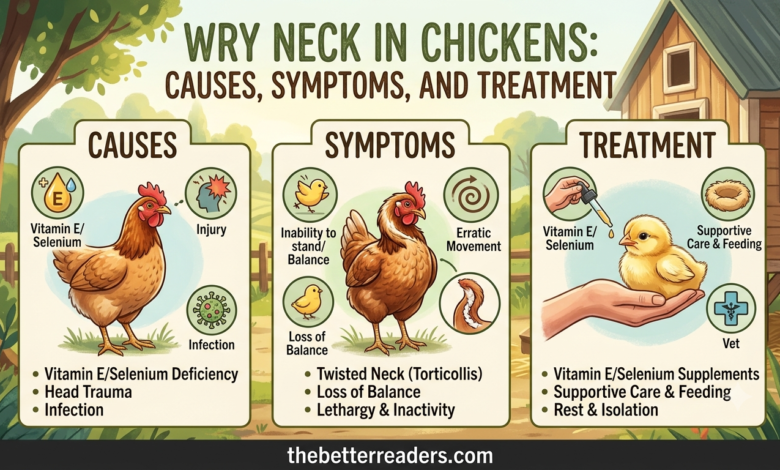
One of the more disturbing things a backyard poultry owner can see is a chicken with a twisted head, a stare into the sky or an a-lopsided walking pattern as he walks backwards in circles.
What is commonly referred to as wry neck chicken can be quite frightening to see but the hopeful news is that most affected birds can make a full recovery if their owner intervenes immediately and correctly. Read on for info on what is wry neck, what causes it and what to do next.
What Is Wry Neck in Chickens?
Wry neck, (also known as torticollis), is not a condition in its own right but is a symptom that manifests itself when the nerves or neck muscles of a chicken are no longer functioning. It is occasionally referred to as crook neck, twisted neck, or stargazing (but should not be confused with the human condition “stargazing,” as in the latter case the head is not affected).
This condition affects the balance and spatial orientation of the body‘s vestibular system, so affected chickens tend to have difficulty in remaining in a straight line whilst walking, standing to attention and in eating and drinking.
What Does Wry Neck Look Like?
Symptoms vary from mild to severe depending on the reason for and duration of the condition. Mild signs of a wry neck may be an occasional tilt of the head or balance loss, however in cases that are severe, there will be a distinct turn of the chicken‘s head to one side, tilt of the head backwards and dragging it along the ground (food and water cannot be raised to the beak). Symptoms such as falling over,
walking in circles, falling to the back and inability to right themselves can be seen. In a moderate to severe wry neck, eating and drinking is very difficult as the bird has a twisted neck preventing the beak being directed to the food and water. In situations of stress (whether excitement or a flock change), symptoms can become more apparent.
What Causes Wry Neck in Chickens?
Wry neck is something of a catchall term, with so many different potential causes that diagnosis can be quite difficult at home.
Though nutritional deficiency is a very common problem, the deficiency of specific nutrients especially vitamin E, selenium and thiamine are all vital for normal nerve and muscle function. This form of wry neck often appears over a period of time and responds favorably to supplementation.
Another common cause of wry necks is trauma to the head which can occur more easily in breeds with a domed/ventiled skull which provides a reduced amount of natural protection. A fall or knock or impact received from another bird may affect the structures which control the head and balance.
This can also be caused by infections such as inner ear infections or bacterial infections such as salmonella, or viral diseases such as Mareks or avian encephalmite, all of which may also cause a similar condition. In rarer situations a genetic predisposition can occur, as can a tumor, toxins or parasites.
Why Do Some Breeds Get Wry Neck More Often?
Within the breeds with vaulted or domed skulls (such as Silkies, Polishs), the ones most at risk are the ones with the most domed skulls, as there is less cushioning around the brain and inner ear structures.
They are therefore more at risk of nutritional deficiencies that affect neurological function, and any knock or fall that in other breeds would be shrugged off by the bird, would have more serious effects. If you keep these breeds, keeping a closer eye on them may be advised.
Is Wry Neck the Same as Marek’s Disease?
Not quite, the two are confused somewhat because wry neck, a virus, and Marek’s disease can cause the same symptoms, again wry neck being a symptom, alongside other signs of nerve paralysis such as ‘the weak paralysis of the legs’.
However, a wry neck is just a symptom and it may be just one of the effects of Marek‘s disease, but equally could be caused by something much less ‘serious’ such as a lack of a vitamin, even just temporarily. This is precisely why it is so important to be able to identify all of possible causes before a definite treatment plan can be decided, since a nutritional case of wry neck would respond much better to the supplements given than a Marek‘s case.
How Is Wry Neck Diagnosed?
There is no one home test that can be done to determine the exact cause of wry neck; diagnosis is usually based on a combination of observation and elimination. Keepers generally start by ruling out trauma, checking for any signs of injury or swelling from any recent accident, and determining if the time of onset is consistent with an accident.
In the absence of trauma nutritional deficiency becomes the next thing to rule out, if feed has been stored improperly, or is approaching its expiry date, or is deficient in vitamin E and selenium. When bloodwork or X-ray is inconclusive or there is no response to treatment veterinary diagnosis can offer more definitive answers.
How Do You Treat Wry Neck in Chickens?
Treatment for wry necks associated with nutritional deficiency focuses on improving vitamin E levels and selenium which is generally supplemented with vitamin E as it helps the body to absorb vitamin E properly. Some owners administer nonprescription vitamin E capsules with a sprinkling of raw or cooked egg as this is a natural source of selenium mixed into some feed for the bird to consume in a convenient amount.
Recommended dosages usually cited by many backyard owners and some poultry resources estimate between 200–400 IU of vitamin E daily for young or small birds and around 400–800 IU for an average adult chicken combined with a small amount of selenium though this should never be given at toxic levels in high doses and these amounts vary by source so checking product labels and seeking advice from a veterinarian or experienced poultry owner is recommended when supplementing.
Generally, in conjunction with supplements, it is advised to isolate a chicken with a wry neck apart from the flock, in addition to decreasing the risk of bullying, this also allows easier hand feeding.
It should be noted that providing soft foods, such as mashed or liquefied egg, moist food, or wet feed, and feeding small quantities more frequently throughout the day, can help ensure the bird receives adequate nourishment in the face of compromised co-ordination.
Massaging the neck can also assist the blood flow and reduce stiffness, but this should be performed gently without forcing the head into an unnatural position.More info Can Chickens Eat Kiwi? A Nutrition and Safety Breakdown for Flock Owners.
Wry Neck Home Treatment Checklist
| Step | What to Do | Why It Matters |
| Isolate | Move the bird away from the main flock | Prevents bullying, allows hand feeding |
| Vitamin E | Give daily per label guidance | Supports nerve and muscle function |
| Selenium | Small daily amount, do not exceed label limits | Helps the body absorb vitamin E |
| Soft food | Offer mashed egg or moistened feed | Easier to eat with impaired coordination |
| Support feeding | Gently support the neck while feeding | Helps align beak with food and water |
| Monitor | Track progress daily | Determines if vet care is needed |
How Long Does It Take a Chicken to Recover from Wry Neck?
The length of time it takes to recover will vary greatly depending on the reason and how quickly the treatment is started. Nutritional deficiencies will begin to show a marked improvement after forty eight to seventy two hours of supplementation; most birds will be fully recovered after two to four weeks.
Cases of head trauma will generally take longer to recover and may only be partial. Wry neck of a genetic etiology or due to an underlying viral infection should improve with supportive care but not completely.
It is good practice to continue the supplementation until all the clinical signs have disappeared rather than until once improvement is seen (as the signs can recur if supplements are stopped too early); supplements should not be given ad lib once the bird is clearly well again.
Can You Prevent Wry Neck in Chickens?
Although it is true that not every case of wry neck can be prevented, such as trauma related or infectious disease related, most nutrition related cases are preventable with thoughtful management of feedstuffs. Keeping feed dry and cool (less than 70 degrees), purchasing smaller, more frequent bags of feed will increase the vitamin E available in the feedstuffs, which loses potency over time, especially if stored in a warm place.
Never feed scratch grains and more than just small amounts of table scraps, always use the highest quality, most complete layer or grower feed available, appropriate to the birds’ end use and age. For some breeds, fallings and trauma caused by their extreme anatomy, can be avoided with minimal handling and less hazards in the coop.
When Should You Call a Vet for a Wry Neck?
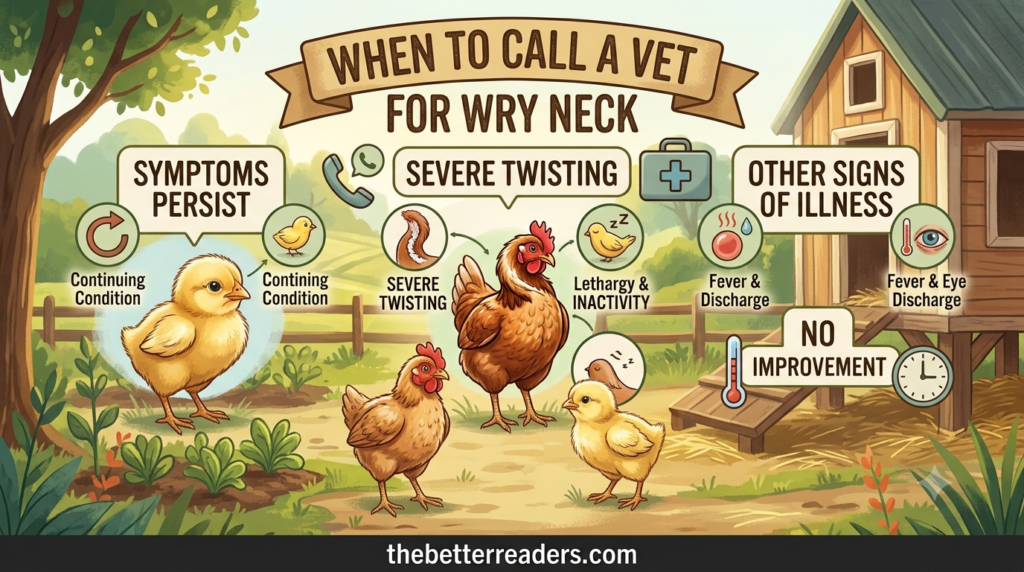
If the condition persists despite daily supplementation for a few days, or, as may be more likely, the bird is very ill from the outset, unable to eat, drink, or stand, vets should be seen rather than just called upon. As described on PoultryDVM, the cause of wry neck is well wide-ranging, with bacterial and viral infections, tumors, and toxins all figuring, several of which cannot be diagnosed or treated by ladybird.
Seeing a vet is a way of ruling out the more exotic from the straightforward nutritional case, and is also in everyone‘s best interests should multiple birds be ill.
Can Wry Neck Be Fatal?
The Wry neck alone is unlikely to be the cause of death. It is certainly one of the underlying causes of death from complications associated with the condition. A severely wiry necked chicken that is unable to eat or drink properly is in danger of dehydration and malnutrition if the problem is not corrected fairly rapidly and this is the reason why hand feeding in a supportive fashion is so important in therapy. If the wry neck is associated with an underlying disease the outlook is far more dependent on this than the wry neck.
Quick Verdict: Wry Neck Chicken
A wry neck can appear very alarming but most cases, especially those due to vitamin E or selenium deficiency, are very responsive to immediate supplementation and emergency hand feeding.
The affected bird should be isolated, the nutritional deficiencies addressed and the patient carefully observed over the following few weeks for a true cure. Non responders or severely debilitating cases should have a vet examination to exclude trauma or disease.
FAQs
What is the fastest way to treat a wry neck in a chicken?
The usual initial response is daily supplementation of vitamin E and selenium, with a single isolated bird, and handfeeding soft food. If the wryneck is caused by the nutritional deficiency, half of the birds will often show an improvement in forty eight to seventy two hours.
Can wry necks in chickens be cured?
In some instances, the answer is yes, particularly in cases caused by a vitamin deficiency, which can return to full health in a period of two to four weeks of diet correction. Injured and diseased individuals may respond only partially.
Why do Silkies get a wry neck so often?
Silkies and other breeds with vaulted or domed skulls have very little natural protection surrounding the brain and inner ear making them more susceptible to nutritional as well as trauma induced wry necks.
Is wry neck contagious to other chickens?
Wry neck itself isn’t contagious but if it is a symptom of a viral or bacterial infection then this may be, so it’s best to isolate an affected bird.
How much vitamin E should I give a chicken with a wry neck?
Usually around 200 to 400 IU for young/smaller birds and 400 to 800 IU for grown ups, although it’s best to check labels and before use with a vet or new keeper. Check before beginning if giving together with selenium.
Should I separate a chicken with a wry neck from the flock?
Yes, separating an affected bird prevents it from being bullied by flock mates and monitoring of the bird during therapy is much easier.