GCF Calculator: What It Is and Why It Trips Up Students
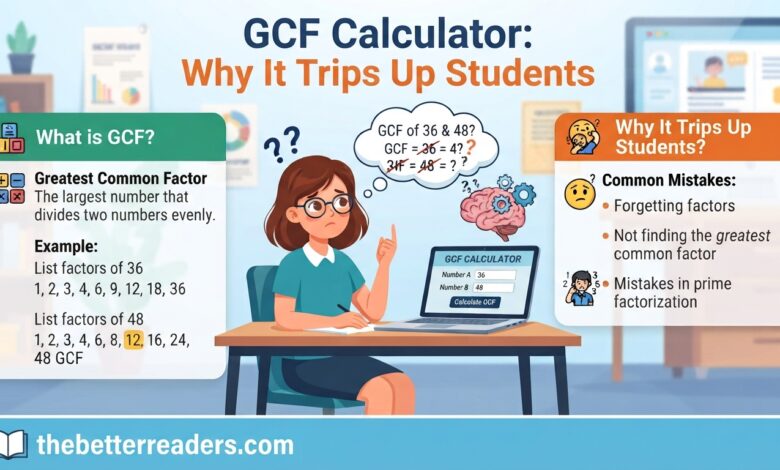
If your child came home with a worksheet full of numbers asking for “the GCF,” and you found yourself just as confused as they were, you are far from alone. Greatest Common Factor is one of those math topics that seems simple once explained, but the terminology alone stops plenty of parents and students in their tracks. A GCF calculator gives you the answer instantly, but understanding what it actually means makes helping with homework, or checking your own work, far less frustrating.
This guide breaks down what GCF really is, when students typically learn it, and how a GCF calculator can help you check homework without just handing over the answer.
What Is GCF, and Why Does It Show Up in Homework So Often?
GCF stands for Greatest Common Factor, meaning the largest whole number that divides evenly into two or more numbers without leaving a remainder. It appears constantly in homework because it is a building block for several other math skills students need later.
Most notably, GCF is the key to simplifying fractions correctly, which is why it tends to show up right around the same time students start working heavily with fractions in their coursework.
When Do Students First Learn About GCF?
Most curricula introduce GCF around fourth or fifth grade, right alongside factors and multiples more broadly. It typically resurfaces in sixth grade when fraction simplification becomes a bigger focus, and again in later grades when factoring algebraic expressions.
This repeated exposure across several grade levels is intentional, since GCF is not a one-time lesson but a foundational skill that keeps getting used in increasingly complex ways throughout a student’s math education.
How a GCF Calculator Actually Helps With Homework
A calculator is most useful as a checking tool rather than a shortcut to skip the thinking entirely. Having your child work through a problem first, then verify their answer with a calculator, builds real understanding while still catching honest mistakes.
This approach also helps parents who may not remember the exact steps themselves, since the calculator confirms whether the final answer is correct even if walking through every step alongside your child feels rusty.
Step-by-Step: Solving a GCF Problem the Way Teachers Expect
Most elementary and middle school teachers expect students to show their work using one of two methods, listing factors or prime factorization, rather than jumping straight to an answer.
- Write out all the factors of each number, or break each number into its prime factors
- Identify which factors the numbers have in common
- Select the largest number from that shared list
- Write that number as your final GCF answer
Encouraging your child to show these steps, even when a calculator confirms the answer instantly, matches what most teachers expect to see on graded assignments and tests.
Real-Life Uses of GCF Beyond the Classroom
GCF is not purely academic. It shows up whenever items need to be divided into equal groups with nothing left over, such as splitting 24 cupcakes and 36 cookies into identical goodie bags, or figuring out the largest possible tile size that fits evenly across a room’s dimensions.
Sharing one or two of these real-world examples with a student often makes the concept click faster than an abstract explanation alone, since it connects the math to something tangible and immediately understandable.
How GCF Connects to LCM (and Why They’re Taught Together)
LCM, or Least Common Multiple, is essentially the opposite question from GCF. Where GCF finds the largest number that divides into a set, LCM finds the smallest number that a set of numbers all divide into.
| Concept | What It Finds | Common Use |
|---|---|---|
| GCF | Largest shared divisor | Simplifying fractions |
| LCM | Smallest shared multiple | Adding fractions with different denominators |
Teachers pair these two concepts together because they rely on the same prime factorization skills, and understanding both makes each one easier to remember correctly instead of confusing which is which.
Simplifying Fractions Using GCF
To simplify a fraction, divide both the numerator and denominator by their GCF. For the fraction 16/24, the GCF of 16 and 24 is 8, so dividing both numbers by 8 gives the simplified fraction 2/3.
This is the single most common reason GCF appears on homework, and mastering it thoroughly makes every later fraction-related topic, from adding fractions to solving fraction word problems, considerably easier to handle.
What’s the Difference Between GCF, GCD, and HCF?
These three terms all describe the exact same mathematical value. GCF is the most common term in American classrooms, GCD shows up frequently in more advanced math and computer science contexts, and HCF is commonly used in British and international curricula.
If your child’s textbook or an online resource uses a different term than what you learned growing up, rest assured it is describing the identical calculation, just under a different name.
How to Check Your Child’s Homework Using a Calculator
Rather than simply reading off the calculator’s answer, compare it against your child’s shown work step by step. If the final numbers match, the work is correct. If they do not match, the calculator helps pinpoint that an error exists, even if identifying the exact mistake still takes a closer look together.
This method keeps the calculator in a supportive role rather than replacing the actual learning process, which tends to build more lasting understanding than simply supplying corrected answers without explanation.
GCF With Larger Numbers: When a Calculator Becomes Essential
Small numbers under 30 or so are usually manageable to work through by hand with a bit of patience. Once numbers grow into the hundreds, manually listing every factor becomes genuinely impractical, and a calculator becomes the more sensible tool even for a student who understands the concept well.
This is a reasonable point to introduce the idea that calculators are tools for efficiency, not a replacement for understanding, a distinction worth explaining directly to older students working with larger numbers.
Common Homework Mistakes Students Make
- Confusing GCF questions with LCM questions, since both use similar-looking numbers
- Missing a factor when listing them out manually, especially with larger numbers
- Stopping too early during prime factorization before fully breaking a number down
- Writing the smallest common factor instead of the greatest by mistake
- Forgetting to show work, even when the final answer happens to be correct
Helping Without Just Giving the Answer
The most effective homework help usually involves asking guiding questions rather than solving the problem directly. Asking what factors of each number they can already identify, or what they remember about prime numbers, often unlocks the next step without simply providing the final answer outright.
Reserving the calculator for the final verification step, after your child has genuinely attempted the problem, tends to build more confidence than reaching for it immediately at the first sign of difficulty.
Why GCF Matters for Later Math Success
Struggling with GCF early on tends to create ripple effects in later topics, particularly fraction operations and algebraic factoring, both of which lean heavily on the same underlying skill. Addressing gaps in GCF understanding early is genuinely worth the extra time investment.
Students who build real confidence with GCF in elementary and middle school typically find algebra’s factoring lessons far less intimidating later, since the core logic remains essentially the same, just applied to more complex expressions.
Practicing GCF at Home Without a Worksheet
Everyday situations offer natural practice opportunities. Dividing a set of snacks evenly among friends, figuring out how many equal teams can be formed from a group, or splitting a collection of items into matching sets are all genuine GCF problems in disguise.
Framing these situations as quick mental math challenges, rather than formal homework, often makes practice feel less like a chore and more like a natural part of everyday problem-solving.
GCF Word Problems Parents Often See on Homework
A common style of question asks how many identical gift baskets can be made from a set number of items, such as 30 apples and 45 oranges, using every piece with nothing left over. This is really just asking for the GCF of 30 and 45.
Recognizing this pattern helps parents spot a disguised GCF question even when the word “factor” never actually appears in the problem itself, which can otherwise make homework help feel more confusing than it needs to be.
How Long Should a GCF Problem Actually Take?
For numbers under 50, a student who understands the listing method should typically finish a problem within a minute or two. Larger numbers requiring prime factorization might reasonably take three to five minutes, especially for a student still building confidence with the process.
If a problem is consistently taking much longer than this, it often signals a gap in understanding factors or prime numbers more broadly, worth addressing before moving further ahead in the curriculum.
A Quick Glossary for Parents Helping With Homework
- Factor: a whole number that divides evenly into another number with nothing left over
- Prime number: a number with exactly two factors, itself and 1
- Prime factorization: breaking a number down into the prime numbers that multiply together to create it
- Multiple: the result of multiplying a number by a whole number, used specifically for LCM problems
- Remainder: what is left over after division, which should be zero when checking a true factor
Signs Your Child Might Need Extra GCF Practice
Struggling specifically with fraction simplification, taking unusually long on basic factor-related homework, or consistently mixing up GCF and LCM questions are all common signs that extra practice with the underlying concept would help.
Catching these signs early, before fractions and later algebra build directly on top of a shaky GCF foundation, tends to prevent bigger frustration down the line when the math naturally becomes more complex.
How GCF Homework Differs Across Grade Levels
Elementary School (Grades 4-5)
Early GCF homework typically sticks to small, friendly numbers under 30, focusing on building the basic concept of shared factors before introducing any formal method like prime factorization.
Middle School (Grades 6-7)
Middle school homework often connects GCF directly to fraction simplification, with numbers growing larger and prime factorization becoming the expected method rather than simply listing every factor by hand.
Early Algebra (Grades 8-9)
By early algebra, GCF reappears in the context of factoring polynomials, applying the same core concept to algebraic terms rather than plain numbers, which can feel unfamiliar even to students who were previously comfortable with basic GCF.
Using a GCF Calculator to Build Confidence, Not Dependence
The healthiest approach treats a calculator as training wheels rather than a permanent crutch. Early on, checking every answer builds trust in the process. Over time, students should be encouraged to predict the answer mentally before checking, gradually reducing reliance on the tool itself.
This gradual shift from calculator-dependent to calculator-optional is a natural, healthy part of mastering any math skill, and GCF is no exception to that general pattern.
Talking to Teachers About GCF Struggles
If a student continues struggling with GCF despite practice at home, it is worth reaching out to their teacher directly, since classroom instruction often includes specific strategies or visual aids not always reflected in a standard homework worksheet.
Teachers can also clarify exactly which method, listing, prime factorization, or another approach entirely, they expect students to use, which helps ensure homework help at home actually matches classroom expectations rather than accidentally introducing a conflicting method.
Why Some Students Find GCF Harder Than LCM, or Vice Versa
Some students naturally find identifying shared factors more intuitive, while others grasp building up to a shared multiple more easily. Neither pattern indicates a deeper math problem, simply a difference in how each individual processes the two related but distinct concepts.
Recognizing which concept clicks faster for your child can help you spend extra practice time more efficiently on whichever one needs additional reinforcement, rather than splitting attention evenly by default.
Making GCF Practice Feel Less Like a Chore
Turning GCF practice into a quick game, such as timing how fast a shared factor can be spotted between two numbers, often keeps students more engaged than a plain worksheet ever could. Even five minutes of playful practice a few times a week tends to build more lasting comfort than a single long homework session.
Celebrating small wins, like correctly solving a tricky pair of numbers without help, reinforces confidence in a way that pure repetition alone rarely achieves on its own.
Final Thoughts
A GCF calculator is a genuinely useful tool, both for students double-checking their own work and for parents helping without necessarily remembering every step themselves. Understanding what GCF actually means, and why it keeps reappearing across several grade levels, makes the concept far less mysterious the next time it shows up on a worksheet or a quiz.
Using a GCF calculator alongside genuine practice, rather than as a replacement for it, tends to build the kind of lasting confidence that carries a student smoothly into fractions, ratios, and eventually algebra.
For a deeper walkthrough of the underlying math with additional practice problems, Math is Fun’s greatest common factor guide offers extra examples worth reviewing together. Explore more homework help guides and educational tools on TheBetterReaders.com.
Frequently Asked Questions (FAQs)
1. What is GCF in simple terms?
GCF, or Greatest Common Factor, is the largest whole number that divides evenly into two or more numbers with no remainder left over.
2. What grade do students learn GCF?
Most students first encounter GCF around fourth or fifth grade, with it resurfacing in sixth grade fraction work and again during algebra factoring later on.
3. How do you explain GCF to a child?
Using a real-world example, like dividing snacks or items into equal groups with nothing left over, often makes the concept click faster than an abstract number-based explanation alone.
4. What is the difference between GCF and LCM?
GCF finds the largest shared divisor of a set of numbers, while LCM finds the smallest shared multiple, making them opposite but related concepts.
5. Why do some textbooks use GCD or HCF instead of GCF?
GCF, GCD, and HCF all describe the exact same value. The term used simply depends on the textbook, curriculum, or country, not a difference in the actual math.
6. How is GCF used to simplify fractions?
Dividing both the numerator and denominator of a fraction by their GCF reduces it to the simplest possible form without changing its value.
7. Should I let my child use a calculator for GCF homework?
A calculator works best as a way to check an answer after your child has attempted the problem themselves, rather than as a first step that skips the learning process entirely.
8. Why does my child keep confusing GCF and LCM?
This is a very common mix-up, since both concepts involve similar-looking numbers and are often taught close together. Practicing both side by side with clear labels usually helps the distinction stick.
About the Author
Syeda is a global link building specialist and content writer. She focuses on producing clear, research-backed educational content that helps students and parents navigate math concepts with confidence.