
Biblioteca Vasconcelos: A Complete Mexico City Visitor Guide
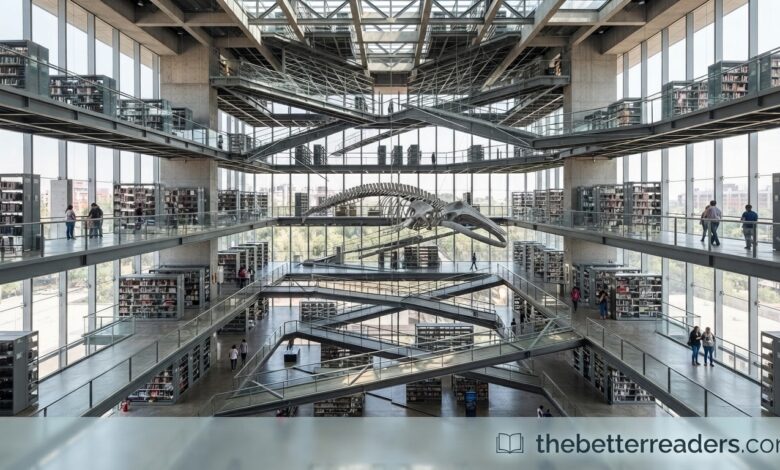
For readers of The Better Readers, biblioteca vasconcelos is more than a recommendation for people who love books. It is one of the rare places where literature, public education, architecture, art and urban life occupy the same space. The modern library in Mexico City’s Buenavista neighborhood opened in 2006 and has become famous for its enormous hanging shelves, transparent architecture and Gabriel Orozco’s Mátrix Móvil. It is also a functioning public library with free access, research resources, children’s services, digital facilities and cultural programming.
If you are deciding whether to visit, this guide answers the practical questions first and then goes deeper into the building’s history, design, collections, artwork, services and cultural significance.
Biblioteca Vasconcelos at a Glance
Before getting into the details, here is the essential information.
| Visitor question | Current information |
| What is it? | Major public library and cultural center |
| Where is it? | Buenavista, Cuauhtémoc, Mexico City |
| When did it open? | May 2006 |
| Admission | Free |
| Published opening hours | 8:30 a.m. to 7:30 p.m., daily |
| Architect | Alberto Kalach |
| Signature artwork | Mátrix Móvil by Gabriel Orozco |
| Collection | More than 600,000 volumes in current official descriptions |
| Children’s services | Available |
| Braille services | Available |
| Digital services | Available |
| Internet/computers | Available |
| Public cultural events | Available |
| Nearest major transport point | Buenavista |
The official library and Mexican government sources provide the core information above, although older official pages sometimes report a collection of 580,000 volumes rather than the newer figure of approximately 600,000.
Why Biblioteca Vasconcelos Matters to Book Lovers
A beautiful building can attract visitors once. A useful library gives them a reason to return.
That distinction is important when understanding Biblioteca Vasconcelos.
Its architecture gets the attention, but the institution exists to provide access to information. Visitors can consult books, use reference services, access digital resources, borrow materials, use computers and participate in cultural activities.
The national public library directory lists services including reading promotion, online catalog access, lending, interlibrary lending, digital services, consultation, credential registration, workshops, courses, exhibitions, concerts, conferences and guided visits.
In other words, the spectacular interior is not the destination’s entire story.
The building is designed around the idea that a large public collection can be open, visible and integrated into everyday urban life.
A Short History of Biblioteca Vasconcelos
Biblioteca Vasconcelos opened in May 2006 in the Buenavista area of Mexico City.
Its location is significant because Buenavista has long been connected with transportation and movement through the city. The library was developed as a major public cultural facility in a part of northern-central Mexico City where a large contemporary institution could serve a broad population.
The official Mexican government description identifies the library as a contemporary architectural example and notes its location beside the former railway station in Buenavista.
The institution’s name honors José Vasconcelos, an influential Mexican intellectual and educator associated with the country’s cultural and educational development.
The name can cause confusion because Mexico City also has the Biblioteca de México “José Vasconcelos” at La Ciudadela. That is a separate library and should not be confused with the modern Buenavista building.
Who Was José Vasconcelos?
José Vasconcelos was a Mexican philosopher, writer, educator and cultural figure whose influence extended well beyond libraries.
His name is associated with education, literacy and the development of cultural institutions in post-revolutionary Mexico.
Naming a major public library after him connects the contemporary building with a much longer Mexican tradition of treating education and access to knowledge as public responsibilities.
That makes the library’s identity especially appropriate for a publication aimed at readers.
The building may look futuristic, but the basic mission is familiar: provide people with access to books, information and learning.
Alberto Kalach and the Architectural Idea
Mexican architect Alberto Kalach designed the building.
The official architectural description emphasizes transparency, natural light and the relationship between the building’s structure and its surroundings. The complex consists of three aligned buildings and multiple levels, creating the enormous interior volume visitors see today.
The architecture is memorable because it changes the expected relationship between a reader and a book collection.
In a conventional library, books might disappear behind walls or sit in predictable rows.
Here, the shelves become architecture.
They are visible from different levels. They create perspective. They frame views. They appear to hang over circulation areas and reading spaces.
The result is an interior that feels closer to a vertical city than a traditional library.
You can look across one level and see another. A walkway can become a viewing platform. A wall of books can become a visual horizon.
This is a major reason architectural photographers find the building so compelling.
The Suspended Bookshelves Explained
The hanging steel shelving is probably the single visual feature most associated with Biblioteca Vasconcelos.
The shelves are arranged through the building’s interior rather than being confined to simple perimeter walls. This creates a layered environment in which books and architecture are constantly visible together.
From the lower levels, the shelves appear to rise dramatically above you.
From higher platforms, the same structures create long lines stretching across the building.
From a distance, they can appear almost weightless.
That visual effect is particularly striking because the shelves are carrying something inherently heavy: thousands of physical books.
The contrast between apparent weightlessness and actual structural load is one of the architectural pleasures of the building.
The Role of Natural Light
Glass is one of the most important materials in the library’s design.
The official architectural information describes the building as luminous because of the transparency provided by its glass roof and walls.
For readers, natural light can make a large difference to the feeling of an interior.
For photographers, it creates another layer of visual interest.
Sunlight moves across the building during the day, changing the appearance of shelves, walkways and open spaces. Shadows and reflections therefore become part of the architecture rather than simply an external lighting effect.
This is also why a photograph taken in the morning can feel noticeably different from one taken later in the afternoon.
Mátrix Móvil: The Whale at the Heart of the Library
If the shelves are the building’s most recognizable architectural feature, Mátrix Móvil is its most recognizable artwork.
Mexican artist Gabriel Orozco transformed a gray whale skeleton into the installation, which hangs within the central library space. The official library history identifies it as an iconic work associated with the building.
The skeleton is enormous.
Placed among shelves and books, it introduces an unexpected natural form into an otherwise highly engineered environment.
There is something almost surreal about the combination:
Books.
Steel.
Glass.
Concrete.
A whale skeleton.
That combination is precisely what gives the central interior its personality.
The artwork also creates a useful conceptual connection. Libraries preserve human knowledge, while a whale skeleton represents biological history and the physical world. Bringing the two together makes the interior feel more like a cultural ecosystem than a simple storage facility.
Did the Whale Artwork Appear in New York?
Yes.
The official library history states that Mátrix Móvil was exhibited at the Museum of Modern Art in New York in 2009.
This is one reason the artwork deserves attention beyond the library itself.
If you visit, it is easy to treat the whale as a spectacular photo opportunity. Knowing something about its artistic history makes the encounter more meaningful.
Instead of seeing an unusual skeleton hanging over books, you are seeing a significant work by one of Mexico’s best-known contemporary artists.
How Large Is the Library?
The scale is difficult to understand from photographs.
The official library information says the site covers about 37,692 square meters and that the building contains more than 44,000 square meters of construction. It consists of three aligned buildings with six levels each.
The national library information also describes a facility capable of serving thousands of people.
This scale explains why the building can support different activities at the same time.
One visitor might be attending a cultural event.
Another may be studying.
A family might be using children’s services.
Someone else could be researching material in the reference collection.
Meanwhile, tourists may be standing in the central space photographing the architecture.
The building has enough capacity and variety to accommodate these different uses without being defined by only one of them.
What Can You Read at Biblioteca Vasconcelos?
The collection is broad rather than limited to one subject.
The library uses the Dewey Decimal Classification system for organizing its general collection. Official information also identifies reference, general, children’s, multimedia, Braille, special and periodical collections.
That means a reader should not approach the institution expecting only a tourist-oriented display of famous books.
It is a real working collection.
Students can use research resources.
Readers can explore literature.
Children can use age-appropriate collections.
Visitors interested in music, multimedia or periodicals have dedicated resources.
The library’s reference and consultation services also extend beyond simply finding a physical volume.
Digital and Internet Services
A modern library cannot rely entirely on printed books, and Biblioteca Vasconcelos reflects that reality.
Official information states that visitors can access computers and portable equipment with internet service. The institution also provides consultation resources and digital services.
This is particularly useful for students and researchers who need to combine physical books with online information.
It also reinforces an important point about the library’s purpose.
The building may be famous because of its shelves, but its function is not frozen in the age of print.
It is designed to provide access to knowledge in multiple formats.
Services for Children and Young Readers
Readers do not have to be adults to find something useful here.
The library directory lists a children’s room, youth room and ludoteca, while its official contacts include a dedicated children’s area.
The institution has also placed renewed emphasis on children and young people in its 2026 development plans.
In May 2026, Mexico’s Secretariat of Culture announced more than 12.3 million pesos in maintenance and conservation funding as the institution reached its 20th anniversary. The announcement included plans to strengthen programming and services for children and young people.
For families, this makes the library more than a place to admire from the outside.
It is a functioning educational environment.
Braille, Audiobooks and Accessibility
The library also provides resources designed for visitors with visual disabilities.
The national library information lists Braille materials, audiobooks and text-reading equipment among the resources associated with its service for blind and visually impaired visitors.
That is worth highlighting because accessibility is sometimes treated as an afterthought in discussions about famous architecture.
Here, it is part of the public-library mission.
If you require a specific accessibility arrangement, contact the library in advance because individual services and operational details can change.
Cultural Events Beyond Books
Biblioteca Vasconcelos also functions as a cultural venue.
Official information lists exhibitions, conferences, concerts, theater, dance, workshops, courses, book presentations, academic activities, storytelling and cinema among its programming.
This helps explain why the library attracts people who may not have arrived specifically to borrow a book.
A library can be a meeting place.
It can host a conversation between authors.
It can provide a space for a performance.
It can introduce children to storytelling.
It can offer a workshop or exhibition.
That broader role is part of what makes the institution important within Mexico City’s cultural landscape.
Biblioteca Vasconcelos Opening Hours and Admission
The currently published schedule is 8:30 a.m. to 7:30 p.m., Monday through Sunday. Admission is free.
These are the figures to remember when planning an ordinary visit.
Still, travelers should check the official site shortly before going because large public cultural institutions can change access arrangements for maintenance, special events or other operational reasons.
This is particularly relevant in 2026 because the institution is undergoing conservation and maintenance work associated with its 20th anniversary.
How to Reach the Library
The library is in Buenavista and is conveniently positioned near major transportation connections.
Current public transit information identifies Buenavista as approximately a three-minute walk from the library and lists nearby Metro, train and bus connections.
For someone visiting Mexico City for the first time, this is an advantage.
You do not need to build a complicated transportation plan around a remote attraction.
The address is:
Eje 1 Norte Mosqueta s/n, esquina Aldama, Colonia Buenavista, Cuauhtémoc, Ciudad de México, C.P. 06350.
Use the official address when checking navigation because the similar names of different Vasconcelos-related institutions can cause confusion.
What Is Near Biblioteca Vasconcelos?
The location allows visitors to combine the library with other nearby destinations.
Mexico City’s official tourism page identifies Fórum Buenavista, the Buenavista transport station and the Tianguis Cultural del Chopo as nearby points of interest.
That means the library can work particularly well as part of a neighborhood-focused itinerary.
Rather than spending an hour crossing the city between every attraction, you can explore several nearby places and make the library one part of a broader day.
For travelers who like cultural districts more than checklist tourism, this approach is often more rewarding.
Should You Visit in the Morning or Afternoon?
There is no universal best time, but morning can be attractive if your main goal is to experience the architecture calmly.
Earlier visits can provide more time to explore before the day becomes busier.
The central interior is also a place where light matters, so photographers may want to observe how daylight interacts with the shelves and glass rather than treating the building as a static backdrop.
If your priority is an event, workshop or specific service, however, schedule should take priority over photography.
Check the current official program before choosing your arrival time.
Can You Take Photographs?
The library’s architecture naturally invites photography, but visitors should remember that it remains a working public institution.
Keep walkways clear.
Do not interfere with readers.
Avoid photographing people closely without permission.
If you are planning a commercial or professional production, contact the library about permissions before bringing substantial equipment.
The best architectural photographs often require very little equipment anyway.
The building itself provides the composition.
Look for repeating shelves, vertical lines, reflections, bridges and contrasts between the scale of a person and the scale of the structure.
Guided Visits
Organized guided visits are available, but they require advance planning.
The library states that tours for the general public must receive prior authorization. Requests should be submitted in writing, and the published requirements specify a minimum of 15 people and a maximum of 30. Requests should be made approximately two weeks in advance, subject to availability.
This is especially relevant for schools, universities, travel groups and cultural organizations.
Do not assume that a large group can simply arrive and request an immediate guided tour.
Individual visitors should instead plan around the library’s ordinary public access unless they have arranged a formal visit.
What Makes the Interior Different From Other Libraries?
The easiest answer is scale.
Many libraries are organized horizontally.
Biblioteca Vasconcelos feels vertical.
The books extend upward.
Walkways cross open space.
The eye is constantly drawn to another level.
Glass allows the exterior and interior to interact.
The whale skeleton introduces an enormous organic form.
The result is an environment where reading is surrounded by architecture rather than hidden behind it.
This may be the building’s greatest achievement.
It makes knowledge visible.
You do not simply enter a building containing books.
You enter a building in which the collection becomes part of the architecture.
Biblioteca Vasconcelos for Architecture Students
Architecture students can find several concepts worth studying here.
The building demonstrates how a public institution can combine circulation, structural systems, daylight and collections into one visual experience.
The relationship between the shelving system and the surrounding structural framework is especially useful to observe.
So is the way the building creates different scales.
At ground level, visitors experience the building as an enormous public interior.
At higher levels, it becomes a network of platforms and viewpoints.
At the shelf level, it becomes a more intimate environment for books and readers.
That changing scale is one reason photographs often fail to communicate how the building actually feels.
Biblioteca Vasconcelos for Serious Readers
For readers, the best part of the building may be the fact that the spectacle eventually fades into the background.
Once you settle into a reading or research space, the architectural drama becomes less important.
The shelves are no longer an Instagram backdrop.
They become what they were intended to be: access points to information.
That is an important distinction.
A successful library should encourage people to remain.
The strongest evidence of Biblioteca Vasconcelos’s success is therefore not how many photographs appear online. It is the fact that students, researchers, families and ordinary readers continue to use the institution.
2026: Twenty Years of Biblioteca Vasconcelos
The library reached its 20th anniversary in 2026.
Mexico’s Secretariat of Culture marked the occasion by announcing an investment of more than 12.3 million pesos in preventive and corrective maintenance and comprehensive conservation. The Mátrix Móvil artwork was specifically included in the conservation work, alongside broader efforts to strengthen services and programming.
This is significant because the building is no longer simply a new contemporary landmark.
It has now become part of Mexico City’s established cultural landscape.
Two decades after opening, the question is no longer whether the architecture was successful as an experiment.
The question is how a major public library can preserve that architecture while continuing to serve changing generations of readers.
A Note About the Collection Size
You may encounter different numbers when researching the library online.
Some official pages state around 580,000 books, while newer official information gives a figure of approximately 600,000. Mexico City’s current tourism description also refers to more than 600,000 volumes.
This is not necessarily a contradiction.
Library collections change.
Government pages are also updated at different times.
For current editorial purposes, describing the collection as more than 600,000 volumes according to current official descriptions is more defensible than presenting an older figure as though it were a current audited count.
Biblioteca Vasconcelos vs. Biblioteca de México “José Vasconcelos”
These names are easy to mix up.
The modern Biblioteca Vasconcelos is in Buenavista.
The Biblioteca de México “José Vasconcelos” is at La Ciudadela in the historic center.
The second institution occupies a historic building whose history reaches back to the former Real Fábrica de Tabacos and whose library history dates to the mid-20th century. Mexico City’s official venue page specifically distinguishes it from Biblioteca Vasconcelos.
If your mental image includes enormous hanging shelves and a whale skeleton, you are looking for the Buenavista library.
A Better Way to Experience Biblioteca Vasconcelos
Do not rush through the building.
Start by walking into the main interior and looking upward.
Then notice how the shelves create depth.
Look across different levels.
Find Mátrix Móvil.
Move to another viewpoint.
Pay attention to the natural light.
Then, after taking in the architecture, remember that you are inside a public library.
Look at the people studying.
Notice the circulation areas.
Think about the fact that the books surrounding you are part of an active collection rather than a museum installation.
That change in perspective makes the visit more interesting.
The architecture is impressive, but the institution is the story.
Practical Visitor Checklist
Before leaving for Biblioteca Vasconcelos, check:
- Current opening hours
- Any temporary closures or maintenance notices
- The current cultural program if you want to attend an event
- Transportation conditions
- Photography requirements if you are planning professional work
- Guided-tour requirements if you are traveling as a group
The library’s official directory also provides current contact information, including the main telephone number +52 55 9157 2800.
Frequently Asked Questions
Is Biblioteca Vasconcelos free?
Yes. General admission and its public library services are free.
What time does Biblioteca Vasconcelos open?
The currently published hours are 8:30 a.m. to 7:30 p.m. every day.
What time does Biblioteca Vasconcelos close?
The current published closing time is 7:30 p.m.
Where is Biblioteca Vasconcelos?
It is located in Colonia Buenavista, Cuauhtémoc, Mexico City, at Eje 1 Norte Mosqueta and Aldama.
Why is Biblioteca Vasconcelos famous?
It is best known for its dramatic contemporary architecture, suspended steel bookshelves, glass-filled interior and Gabriel Orozco’s whale-skeleton artwork.
Who designed Biblioteca Vasconcelos?
The building was designed by Mexican architect Alberto Kalach.
Who created the whale skeleton artwork?
Mexican contemporary artist Gabriel Orozco created Mátrix Móvil using a gray whale skeleton.
How many books are in Biblioteca Vasconcelos?
Current official descriptions place the collection at more than 600,000 volumes, while some older government sources list approximately 580,000.
Can anyone use Biblioteca Vasconcelos?
It is a public library offering services to visitors and readers. Specific services may have individual requirements, so visitors needing a particular service should check with the institution.
Does Biblioteca Vasconcelos have internet?
Yes. Official information lists free computer and internet-related services among its facilities.
Does Biblioteca Vasconcelos have children’s books?
Yes. It has children’s and youth facilities and collections.
Does the library have Braille resources?
Yes. Its services include Braille materials and resources for blind and visually impaired users.
Can you borrow books from Biblioteca Vasconcelos?
The library offers both on-site and home lending services, subject to its library procedures.
Can tourists take photographs?
The building is widely photographed, but visitors should respect library operations and other users. Professional or commercial photography should be confirmed with the institution beforehand.
Can groups book a guided tour?
Yes, but organized visits require advance authorization. The library’s published policy specifies groups of 15 to 30 people and advance planning.
Is Biblioteca Vasconcelos the same as Biblioteca de México?
No. They are separate institutions in different parts of Mexico City.
Is Biblioteca Vasconcelos worth visiting?
Yes, especially for readers, architecture enthusiasts, photographers, students and travelers interested in free cultural attractions in Mexico City. Its combination of a working public library and major contemporary architecture makes it unusual.
Final Verdict
Biblioteca Vasconcelos is the kind of destination that becomes more interesting the longer you stay.
At first glance, it is an extraordinary piece of architecture.
Then you notice the shelves.
Then the whale.
Then the people reading.
Then the children’s spaces, digital resources, cultural programming and gardens.
Eventually, the building stops looking like a spectacular backdrop and starts making sense as a public institution designed around access to knowledge.
That is why it deserves attention from readers as much as from travelers.
For anyone interested in books, architecture or the cultural life of Mexico City, a visit offers something that photographs cannot fully provide: the experience of standing inside a library where the collection itself has become part of the architecture.
For additional reading-focused culture and destination features, explore The Better Readers. Before visiting, verify current opening hours and special arrangements through the official Biblioteca Vasconcelos website and the Mexico City government visitor guide.